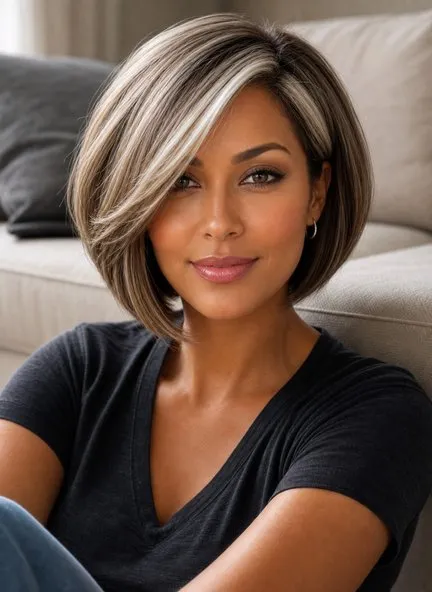
Sleek Straight Side Bangs
Long side-swept bangs on glass-straight hair ask more of your flat iron than your stylist. Who the look flatters, what it really costs in heat and humidity, and how to see the bangs on your face.
- Flatters
- ovalroundoblongheartdiamond
- Upkeep
- high
Ask your stylist for
“a glass-smooth blowout on a deep side part, the front section swept across my forehead, and the ends tapered rather than blunt”
Opens the app on iPhone & Android. One selfie, no salon visit.
Not sure it is you? Find your face shape first.
The side bangs here are longer than the brow and blend straight into the lengths, which means that on most heads they are a styling decision rather than a scissors one — if you already have any face-framing length, this is where you sweep it, not something you cut. If your front is genuinely all one length, a stylist tapering a couple of inches into that panel is the least committal fringe there is: it grows back into face-framing layers instead of into an awkward stage.
What actually makes it look glassy
Not from serum. A cuticle lying perfectly flat reflects light in one direction, and that comes from tension and temperature control — a proper blow-dry with the nozzle aimed down the hair shaft, then one slow flat-iron pass at the lowest heat that works, rather than four fast hot ones. Oil goes on the mid-lengths afterward, never before. If your hair is porous or color-treated and looks dull no matter what, a salon gloss will do more in twenty minutes than any bottle you own.
The faces a straight vertical line helps
A flat curtain of hair narrows whatever it hangs beside, so round and heart-shaped faces gain length from it. Longer faces get rescued by the fringe itself, which cuts the forehead in half diagonally and shortens the whole vertical. Diamond faces benefit from the sweep adding some width where the forehead is narrowest. Square jaws are the one real caution: hair pressed dead straight and stopping level with the jaw draws a hard line right across the widest point. Keep the ends past the collarbone, or let the fringe fall heavier and softer.
The cumulative cost of heat
Forty-five to seventy-five minutes in the chair, depending on how much hair you have. It holds two to four days if you do not wash, and longer if you wrap it at night or sleep on silk. Humidity ends it, and nothing sold as anti-humidity truly prevents that. The cumulative cost is the honest part: weekly high heat shows up as breakage through the mid-lengths on fine hair, and on coily hair repeated pressing causes heat damage that does not revert. Use a heat protectant every single time, keep the iron under 380°F, and treat this as an occasional look rather than a standing habit.