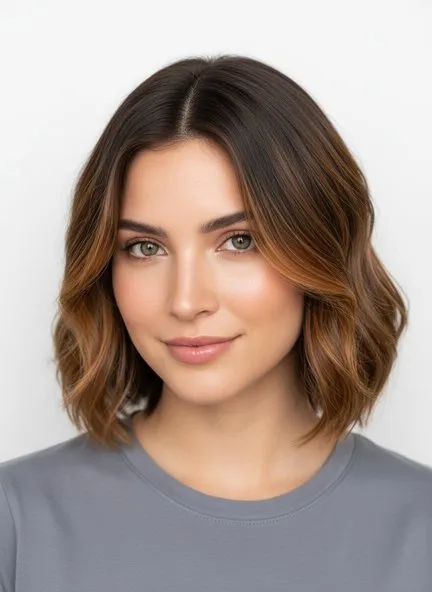
Beachy Waves
Beachy waves are a set, not a haircut. The length and texture they need, how long the bend really lasts, and the ask that avoids ringlets — see them on your own selfie first.
- Flatters
- ovalsquareheartdiamondoblong
- Upkeep
- low
Ask your stylist for
“loose bends rather than ringlets — alternate the direction of the iron, leave the last two inches straight, and break the set up with your fingers instead of a brush”
Opens the app on iPhone & Android. One selfie, no salon visit.
Not sure it is you? Find your face shape first.
Beachy waves are a set, not a cut — nobody takes an inch off you to get them. The whole look is a bend put into hair you already have: an S that starts somewhere below the ear, travels down the length, and deliberately stops short of the ends. That unfinished last inch is what separates a beach wave from a curl, and it is the detail most people forget to ask for.
The texture it actually needs
Below the shoulders is the working minimum. Any shorter and the bend has nowhere to travel, so it reads as a flick. Medium and coarse hair holds a wave for days and does most of the work itself. Fine hair is the hard case — it takes the wave beautifully at three in the afternoon and has dropped it by eight, unless every section is cooled completely in a clip before anyone touches it. Glass- straight, high-shine hair is the most stubborn of all, because there is nothing for the wave to grip.
If your hair is tightly coiled, this is the wrong ask. You already own texture; a diffused set or a twist-out gets you a far better version of undone than a flat iron ever will, and without the heat.
Face shape decides where the S begins
Width that begins at the cheek widens the face. That is a gift on a long or narrow face and a problem on a round one, so if your face is round, ask for the wave to start below the jawline and for the crown to stay flat. A square jaw softens under waves that fall past the chin. Heart and diamond faces get the most from it, since width through the mid-lengths balances a narrow chin.
Wear time, and why day two wins
Forty minutes in the chair, and one to three days of wear depending on your texture. Day two is usually the better day — flatter at the root, looser through the length, closer to what people actually want from the look. Sleep in a loose braid, refresh at the roots with dry shampoo, and resist re-ironing the same sections. Humidity either softens the set into something better or frizzes it into something worse, and no product settles that argument for you.